Article: Standing With My Father at Cooper Hewitt
Standing With My Father at Cooper Hewitt
I found myself standing inside the exhibition at the Cooper Hewitt Smithsonian Design Museum, surrounded by people, yet entirely alone.
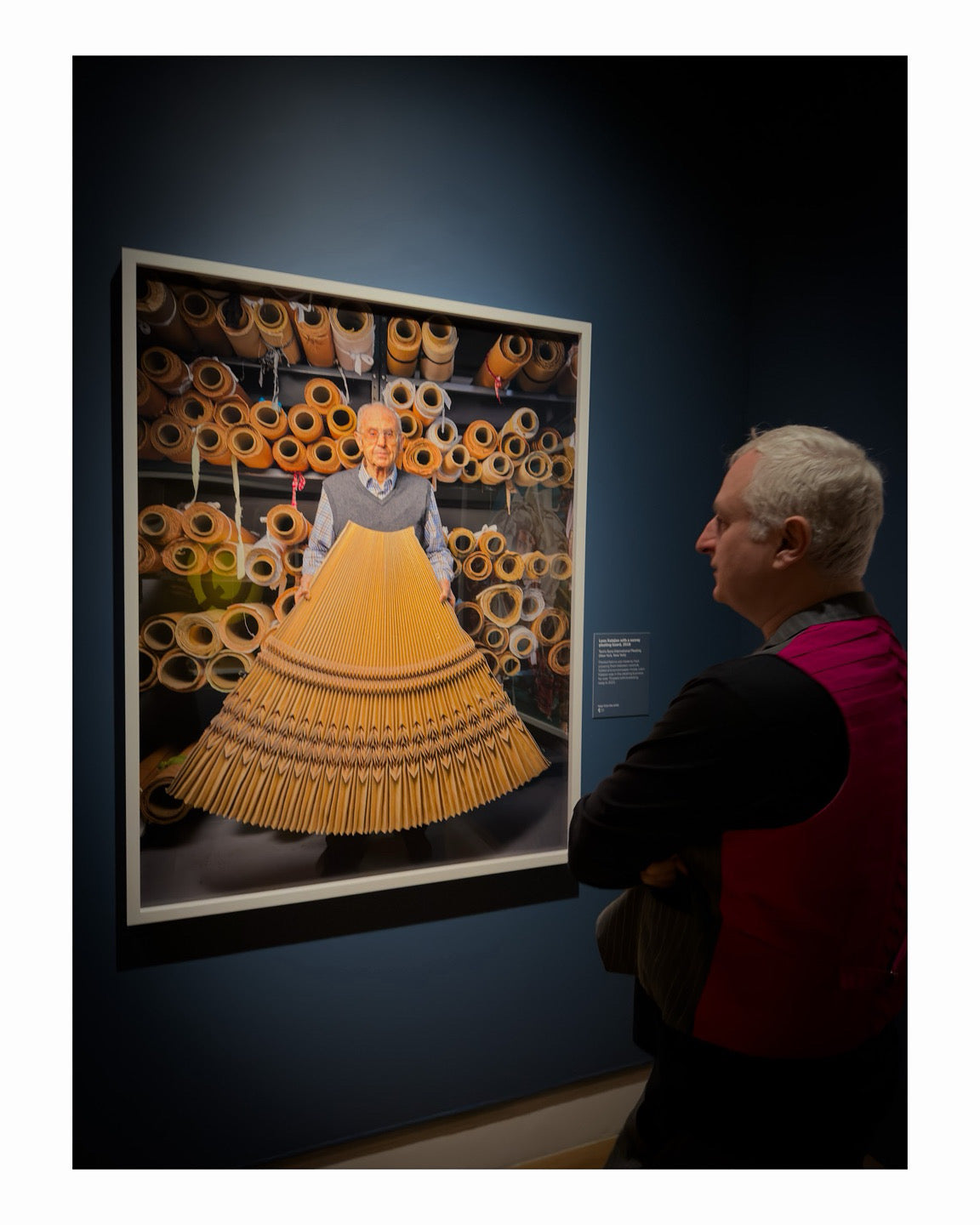
My father’s photograph was tucked into a small room in the corner. I ran to find it first, instinctively, and once I did, I never really left. The room was busy, but that corner felt quiet. Contained. Almost private.

When I first saw the photograph, what I felt wasn’t emotion so much as disbelief. It didn’t register immediately. This was the first time I had ever seen the image printed at such a high level — properly scaled, beautifully lit, given the aesthetic care it deserved. And suddenly, there he was. I could feel his presence. You could see him.
It took time for it to sink in.
As I stood there, people began to gather, waiting to look. I realized I was blocking the view and stepped aside, apologizing. “I’m sorry,” I said. “That’s my father.”
Something unexpected happened every time I said those words. People lit up. Their relationship to the photograph changed instantly. What had been an image became a person. A life. A master. And without planning it, that became the rhythm of the evening. I stood beside my father’s portrait for hours, telling people who he was ... not to brag, but because it gave the work deeper meaning.
In a strange way, I wasn’t taking anything from the moment. I was giving something back.
The photograph itself says more than words ever could. If a picture is worth a thousand words, this one speaks ten thousand. You don’t just see a man looking back at you, you see a lifetime of mastery. Presence. Intelligence. Commitment. You know immediately that you’re looking at someone who knew exactly what he was doing.
If I had to describe my father in one sentence to someone who never met him, it would be this: absolute dedication to his craft.
My father never needed the spotlight. In fact, throughout most of his career, he deliberately chose not to work under his own name. When he established companies or labels, he often created names or adopted fictitious ones, sometimes using other people’s names, not because he was working for them, but because authorship and visibility were never the point. Of the seven or eight decades he worked, only a brief period carried his own name. Recognition was never the goal. The work was.
What he loved was hearing that his work made people happy. He loved when someone noticed the extra care, the subtle differences that only come from attention and intention. Every single piece he pleated was treated with respect, focus, and full mental presence.
That presence is what made him exceptional.
Many people, when they repeat the same task over and over, go on autopilot. The work becomes mechanical, almost subconscious — like driving a car. For my father, it was the opposite. He stayed deeply aware of what was happening in front of him. That awareness allowed him not only to perfect his craft, but to build an entire technology around it.
This is something I feel eternally grateful for and blessed by. He passed on something that cannot be taught quickly, or easily. It took me twenty years before I could fully understand what he was doing, and why. Only then did I realize the depth of what he had given me.
The exhibition, Made in America, curated by Susan Brown and seen through the lens of Christopher Payne, exists to honor the people who build, make, and sustain this country often invisibly. Seeing my father included in that story, preserved within a Smithsonian institution, feels like one of the first true acknowledgments of a life devoted entirely to mastery.
My father never asked to be seen.
He dedicated his life to making his work visible.
That night, he was seen.
And in many ways, this feels less like an ending and more like a beginning.
If you’d like to see this exhibition in person, Made in America: The Industrial Photography of Christopher Payne is on view at the Cooper Hewitt Smithsonian Design Museum at 2 East 91st Street, New York, NY 10128 through September 27, 2026.
Visit the museum’s website to plan your visit and get tickets: cooperhewitt.org/exhibitions/made-in-america.